Wednesday, April 9, 2014

April Microplastics Beach Blitz is in Full Swing

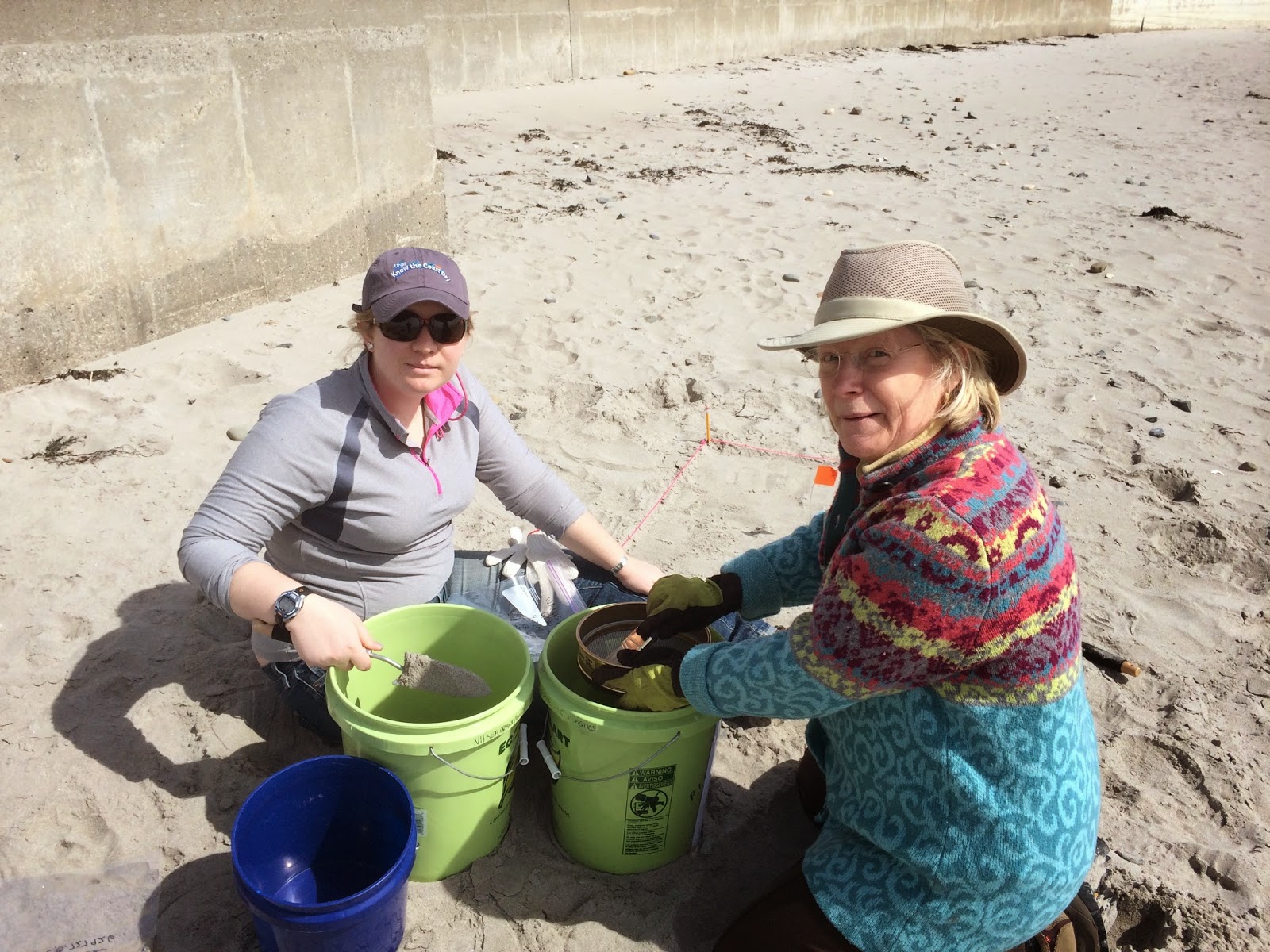
Our new recruits! 2 beaches down, several more to go!
Finally!! After a very long winter and some panic that the weather would not improve in time for microplastics sampling season, here we are, in full sampling mode!  We have had several successful training sessions at the Blue Ocean Discovery Center in Hampton and I am so pleased with our new recruits! Their patience and eagerness to help out with this "kinks-still-being-ironed-out" project has been refreshing and really enjoyable.  The microplastics study is really exciting and interesting but it is also a work in progress as we try and figure out the best way to sample our beaches given the weather, topography, the number of volunteers and the time that it requires. With all this in mind, the fact that we have such enthusiastic volunteers is wonderful and I thank you!


Wallis Sands State Park-sampled April 7, 2014
For the entire month of April, we will be sampling 12-15 NH beaches and I am pleased to say that we have completed two beaches already, Hampton Beach State Park and Wallis Sands State Park. Both of these sampling outings took place on gorgeous days, which made the time pass by! These two beaches are part of 5 beaches where we have added two more sites with the hope of capturing more of  a "microplastics signal".  By adding more samples, we hypothesize that we will be able to collect more microplastics and get a better idea of how and where microplastics are accumulating. Thus far, we have observed that microplastic accumulations appear to be very patchy. Hopefully, this subset of beaches with the extra samples will help elucidate some patterns so that we can modify our protocols if need be.
Microplastics on our beaches-this is what we are looking for!
In addition to some new Blue Ocean volunteers, we have a star team from the Coastal Research Volunteers (CRV) from UNH. This group of 5 are returning to sample more beaches and they have experience with the protocols and the technology and have been eager to get going. They will be sampling 4-5 beaches that have one designated sampling site.


We hope to finish our sampling by April 30th and we have some dates reserved for the next phase of the data collection- SORTING! Sorting the samples will occur in May which will then give us time to enter the data and do some preliminary analyses before we have our final sampling blitz in August.


We are always looking for extra hands so if you are interested in volunteering, please get in touch with Gabby Bradt or Jen Kennedy for more information.

Friday, February 14, 2014

Want to Help with a Unique Project? Volunteer for Our Microplastics Study!

Microplastics sampling at Wallis Sands Beach
Want to volunteer outside? Interested in marine conservation and research? Help with our microplastics study! 

Blue Ocean Society for Marine Conservation and NH Sea Grant are working together to conduct a pilot study on microplastics (small plastics) on New Hampshire beaches. Below is a two-minute video with more information:


Want to help?

Here's what it involves:

  • Samplers needed: This work involves being outside on the beach, collecting and sieving sand samples. Fair warning: the work is conducted outside, in sometimes cold weather, and can be a bit tedious, but it is very important! This is the first study of its kind in New Hampshire. The time commitment will be approximately 6 hours in April and August for sample collectors, plus 1-2 hours for training. We are looking either for teams of 5 people, or individuals willing to be matched to a team.
  • Sorters needed: We are also looking for volunteers to work indoors to help sort the samples once they are collected. Time commitment for sorters is about 12 hours total between May and October. April through October. 

For more information:

Join us for an information session on Tuesday, February 25, 2014 at 6 PM at the Blue Ocean Society office at the Gov. Langdon House, 143 Pleasant Street, Portsmouth, NH. The training will be held in our conference room, which is all the way in the back of the buildilng, on the 2nd floor. Please RSVP to jen@blueoceansociety.org or call 603-431-0260 if you plan on attending.  We hope to see you there!

Thursday, January 23, 2014

Adopt-a-Beach Program Expands to South Portland, Maine!

On Sunday, January 12, I had the pleasure of spending a couple hours at the beach with Sarah Heeley and Meghan Pryor and their families.  Sarah and Meghan have just become our first Adopt-a-Beach group in South Portland, Maine! They adopted scenic Willard Beach, a place that was very busy with families and dogs on the nice, sunny day.

A beautiful day for a cleanup on Willard Beach!
Sarah learned of the Adopt-a-Beach opportunity through her mother, Susan DeQuattro, who adopted Cape Neddick Beach in York, ME nearly a year ago. Sarah is a licensed massage therapist who lives near Willard Beach. She said in her adoption application, "I love the beach and want to help keep it clean!  I also want to help educate our community, bring awareness about clean beaches, and set a good example for our daughter." In addition to other family members, Sarah and Megan's daughters Charlotte and Eden - both 2 years old - came along, showing that beach cleanups are great for all ages!

The Adopt-a-Beach program requirements are fairly minimal. All you need to do is download and read our brief handbook (available online here), fill out and send in an application, and we'll set up your first cleanup. A Blue Ocean Society staff member conducts the first cleanup with you and we'll bring you all the supplies you need for your cleanups. We ask for a one-year commitment to cleaning your site once per month. Most cleanups take only an hour - so really, it is a commitment of about 12 hours per year.
Cleaning the beach
At the first Willard Beach cleanup, we picked up about 12 pounds of litter. The crazy thing is that it was 12 pounds of mostly very small things - small pieces of foam, plastic and cigarette butts. But even these little pieces count, because they can potentially be swallowed by animals such as birds and fish.

Thanks to Sarah and Megan and their families for their commitment to a healthy marine environment!


Megan & Eden Pryor, Sarah Heeley

Saturday, January 11, 2014

Cleanups Necessary, Even in the Winter

Volunteers at a foggy Jenness Beach cleanup - the first of the year!
Our first public cleanup of the year showed that cleanups are necessary even in the winter. Luckily, today felt more like a fall or spring day than a day early in January.  Nine of us trekked along Jenness Beach, picking our way around the ice as the fog hovered around us.

The beach was relatively clean-looking - we theorized that the recent heavy seas, winds and tides had washed a lot of debris clear across the beach and into the yards of the beach homes and roadways lining the beach.  Still, we managed to collect 25 pounds of litter in a little under an hour!

Plastic and foam pieces were prevalent, as were cigarette butts and bottle caps.  As is often the case in the winter time, we found lots and lots of dog poop - some even already bagged up.

Thanks to the dog owners who are diligent about picking up after their dogs, and thanks to the beach goers and homeowners who join in our efforts by picking up litter they find that has washed into their yards, or that is on the beach during their walks.  It's unfortunate that we have to pick up litter on the beach at all, but I'd rather pick up pounds and pounds of garbage than think about the effects that litter could have on marine life if it washed out to sea.

Our next cleanups are next weekend - on Saturday, January 18 we have cleanups at North Hampton State Beach at 9 AM, and at Cape Neddick Beach in York, ME at 10 AM. Both are small, beautiful beaches that could use your help! If you'd like to sign up for either of these cleanups, email info@blueoceansociety.org or call the Blue Ocean Society office at 603-431-0260. We hope to see you there! Thanks to the dedicated volunteers who came out today!

Want to support our beach cleanups? Click here to become a member or adopt a whale!

Monday, January 6, 2014

Happy New Year! First Cleanup Jan 11

Winter is a great time to be at the beach!
Happy New Year!

This is a long-overdue post to this blog, but I'm happy to say that the New Year has brought new resolve to post more frequently...starting today!

This is just a quick post to let you know that our first public beach cleanup of the year will be this Saturday, January 11, at 10:30 AM at Jenness Beach in Rye, NH. All supplies will be provided, although you're welcome to bring your own gloves and reusable bags. We'll also have hot coffee available (you'll get bonus points if you bring your own mug!). To learn more about Blue Ocean Society beach cleanups, click here. If you'd like to see data from our Jenness Beach or other cleanups, click here.

The cleanup usually takes 1-1.5 hours, and is conducted rain, snow or shine (unless travel is unsafe). If it is canceled for some reason, we'll post a message on Facebook and leave a message on our answering machine at 603-431-0260.

RSVP'ing is helpful, but not necessary. If you'd like to RSVP, call 603-431-0260 or e-mail info@blueoceansociety.org. We hope to see you there!

Thursday, August 1, 2013

An inside look at Waste-to Energy


Derelict fishing gear getting ready to be recycled and turned into energy! Photo courtesy of B. Zeiber, NH Sea Grant

NHSG/UNHCE Extension Specialist, Dr. Gabby Bradt and NHSG Doyle Fellow Katherine Rafuse recently attended a reception for the Fishing For Energy Partnership and got a tour of the facility where N.H.’s marine debris — specifically, derelict fishing gear — is turned into energy.  Dr. Bradt spoke briefly about the progress of the program in NH(which is run in partnership with Blue Ocean Society for Marine Conservation) .
 
The Fishing for Energy Primary partners. Photo courtesy of B. Zeiber, NH Sea Grant
There are seven ports in northern New England that have dumpsters dedicated to derelict fishing gear, like old lobster traps, fishing nets and monofilament line. This access to dumpsters specifically for fishing gear is critical because most transfer stations won’t take the gear. This past April, the 20+ tons of derelict lobster traps that were collected from NH beaches in the Annual Lobster Trap cleanup, were taken to Covanta Energy, an energy-from-waste plant in Haverhill, Mass., as part of the NH Marine Debris to Energy Program. This program provides a safe, reliable way for fishermen and cleanup volunteers to dispose of the fishing gear they encounter at sea or on the beach.

More than two million pounds of derelict fishing gear has been collected as part of NOAA’s nationwide Marine Debris to Energy Program since 2008. NOAA has partnered with the National Fish and Wildlife Foundation, Schnitzer Steel and Covanta Energy to continue providing the services necessary to collect and convert 300,000 pounds of fishing gear annually into energy for use in our homes.
Fishing rope, derelict lobster traps and other fishing debris. Photo courtesy of B. Zeiber, NH Sea Grant
As a mass-burn facility, Covanta does not need to break down the trash and fishing gear before combusting it. They first recycle whatever they can and remove anything radioactive. Whatever is left gets visually inspected, piled up and picked up by a giant claw and placed in the boiler for combustion.

This Covanta plant has pollution control technologies associated with it, so it’s more than just an incinerator. It captures the energy from the process and sells about 40 Megawatts per hour to the utility companies, or about 1,000 Megawatts per day, powering approximately 40,000 homes in a city the size of Haverhill, said Joe Becker, facility manager at Covanta.

L-R: NHSG Doyle Fellow, Katherine Rafuse, NFWF coordinator, Erin Hoffman, NOAA Marine Debris Program Deputy Director, Nanacy Wallace and NHSG Fisheries Extension Specialist, Dr. Gabby Bradt. Photo courtesy of B. Zeiber, NH Sea Grant

For more information on the energy-from-waste process, please visit: http://www.covantaenergy.com/what-we-do/energy-from-waste.aspx


By Rebecca Zeiber
NH Sea Grant, Communications

Tuesday, May 14, 2013

Heading to the Shoals, Again

(the following was reprinted from Blue Ocean Society's May 2013 Enewsletter)


This week, we're donning our hard hats and heading out to the Isles of Shoals for another cleanup at Appledore Island. Appledore is the largest of this group of nine islands that lie 5 miles off the coast of Kittery, ME and Rye, NH.

Cleanup Team, September 2012 aboard the fishing vessel Yesterday's Storm

Why the hard hats? While we don't expect any trash to drop on our heads, we are wary of gulls, who nest on the island at this time of year and vigorously defend their nests. During this cleanup, we'll be surveying and removing debris from three spots on the island - three spots we cleaned last year in June, and again in September.

Some of the findings on Appledore Island, June 2012

There's a few reasons for picking these spots. A resurvey will help us figure out how long it takes for marine debris to accumulate in these areas, and what type of debris is washing up. They are also three spots on the island that are less inhabited by gulls at this time of year.

Last year, five of us picked up 557 pounds of debris in 5 hours. This was the first time these 3 areas had been cleaned-up, so we are hoping for less debris this time, but are interested to see what is out there after the stormy winter we had.  We'll keep you posted, and will also post some pictures and updates here on our blog!