Tuesday, September 11, 2012

Appledore Cleanup - Take 2

Babies R Us or Appledore Island?

When we began the Isles of Shoals Cleanup Series this summer- we had no idea what exactly it would entail.  We had a general idea of what was on the islands and pre-cleanup surveys indicated that these Islands, even though they were five miles offshore, were still sites of debris accumulation and some had  more than their fair share of derelict lobster traps.  We began with Appledore Island, the biggest of all the Isles of Shoals and home to the Shoals Marine Lab because it seemed like the one that would be most accessible and a logical place to start.  As part of the project, we wanted to visit at least a few of the islands twice, once in the beginning of the summer and once in the fall to see what would accumulate between the cleanups.  As it happens- Appledore will be our only island  that will be visited twice in the same field season due to timing, scheduling and the crazy amount of logistics that it takes to coordinate these offshore cleanups!

During our first visit to Appledore we were astounded to discover just how much debris and derelict lobster gear was on the island. At the end of that cleanup we managed to haul off the island over 500lbs of debris and gear.  Needless to say, we were all looking forward to seeing what we would be hauling off the island on this last trip. On Friday, September 7th, our crew from NH Sea Grant, Blue Ocean Society and Captain Lee Schatvet from F/V Yesterday's Storm left from Rye Harbor and steamed out to Appledore. On this trip, we would basically have the island to ourselves as the marine lab was being  prepared to shut down for the winter.  It was an entirely different experience and rather nice and peaceful, actually. Without the constant squawking and dive bombing of  nesting gulls and the general hubbub of an island full of students and staff, it really felt like we were stranded in the middle of nowhere.
Site # 1- Smith Cove
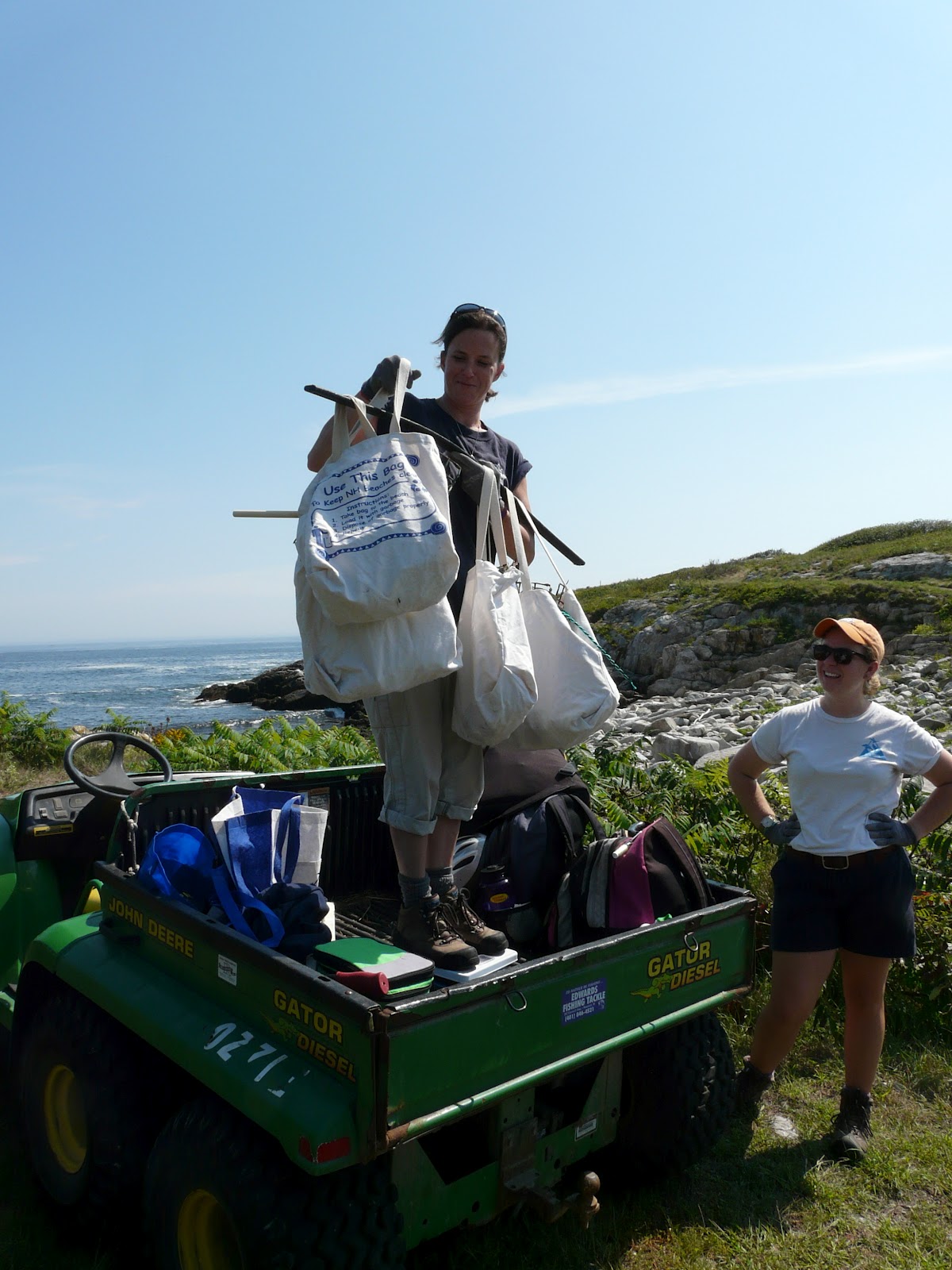
 Once we landed on Appledore, we picked up the Gator tractor and headed to the first sight that we cleaned up on the last trip.  Smith Cove is the largest of the sites that we went to. Unfortunately, because we couldn't get Maine Marine Patrol to accompany us on this trip, we had to leave the same lobster traps behind for yet another season.  The biggest surprise was that even after a busy summer had passed between the first cleanup and the second,  we found very little debris at this site.  And though that is great news for the Island, it was surprising.  I had expected more- even if lobster gear hadn't washed up, I was expecting the usual culprits- plastic bottles, styrofoam, bags and rope. We found representatives of each but not much at this site.

Smith Cove 
We hit Broad Cove next and initially it looked like there would very little there as well.  In fact, in the area below the high water line there was significantly less litter compared to what we found last time but since this is still a coastal cleanup we started looking a bit higher up on the beach and discovered a lot more bits and pieces of metal, traps, ropes, bottles, caps and cans. We were also able to cover more of this beach without nesting gulls nearby!
Broad Cove
BOS's Jen Kennedy and Abby Groneberg weigh the trash pre-sorting!
After Broad Cove we went to a new site- one we hadn't been able to access back in June because of the gulls. This was Devil's Glen. The climb to the site was lovely with many butterflies and pretty flowers but once we got to the site it was a little treacherous getting down.  Fortunately- there was very little there as well except a few plastic bottles and some abandoned buoys.

BOS's Amy Warren collecting at Devil's Glen.
Because of the nesting gulls back in June, there was a site that we didn't effectively cleanup and that was Sandpiper Beach.  This time, as we were melting under the very hot sun, we were able to spend a good chunk of time here.  Again, however, we were surprised to find very little.

Lunch Break overlooking Sandpiper Beach

Stuffed Giraffe in a bag...an opened McDonald's Happy Meal toy...sigh 
Algae filled tide pool- and yes...there were fish living in there...
Our final site for the day was the beach right by the tidal swimming hole and near the High Water Dock. By this point, we were overly thirsty and over-heated but we felt we couldn't just stop.  So we pushed on- although moving a bit slower.  And wouldn't you know? I believe we got most of our litter from this beach and the surrounding rocks.  There was so much rope and bits of plastic and bottles and styrofoam and other very random things.  We also found 13 disks from the Hooksett wastewater treatment plant spill on 3/6/11.

The SML "swimming pool"- our last site of the day...

One of 15 total disks of the day...

What is it about toys and this island??? 


Our peculiar finds...

Oh what a tangled web we weave...

Final weigh in...

Was this a successful cleanup? I would say absolutely yes! Our final weight  (76 lbs)may have been small- nothing compared to some of the hauls we have had this summer- but we are at least leaving Appledore at what we feel is a good baseline of  "clean", from which we can better measure accumulation rates in the future.  Now this isn't an exact science- we have to take into account weather, surf and other environmental factors that will likely impact any of our results and maybe after a few storms over the winter the type and amount of debris that will wash up will be significant.  But at least we know what the island looked like when we left...pretty darn clean!

Final Trash Totals from Appledore Cleanup #2:


76.1 pounds
547 pieces of trash, including:

5 Gloves
5 nets/bait bags
2 Traps/pots
14 Buoys
32 Pieces of rope >1m
89 Small rope
6 Beverage cans
10 Balloons
4 Straws
6 Plastic bags
24 Plastic beverage bottles
13 Bottle caps (plastic)
1 Motor oil container
1 Cigarette butt
2 Styrofoam cups
1 Strapping band (open)
1 Strapping band (closed)
 13 pieces of flagging
2 Lobster bands
2 Chip bags
1 Fake flower
1 Doll
3 Zip ties
1 Piece of pottery
1 Wire
15 Hooksett Disks
52 Pieces of Styrofoam
8 Pieces of plastic
1 Twist tie
6 Bungee cords
72 Trap pieces
68 Pieces of plastic
7 Trap doors
1 Rubber band
1 Jug water bottle
1 Metal bottle
11 Pieces of glass
1 Lure
1 Stuffed giraffe in a plastic bag from a Happy Meal
1 Paper
1 Wreath
1 Fish hook
1 Blanket/cloth
6 Balloon strings
8 Wrappers
1 Nerf football
3 Pieces of string
1 Metal cap
2 Nylon straps
6 Pieces of rubber
1 Pen
6 Pieces of glass
3 Pieces of aluminum
1 Budweiser hat
1 Cardboard box
2 Paper towels
1 Ribbon
1 wood/fiberglass Bait box 3’ x 2’
1 Shot gun shell


We would like to thank the Shoals Marine Lab for once again allowing us access to the island and to the gator and once again to Capt. Lee Schatvet and Yesterday's Storm,NH Port Authority and NOAA for their help! 


P.S. A quick update on the last Appledore cleanup. Back in June we had the assistance from Maine Marine Patrol Officer Dave Testaverde- this time around he was unavailable, so we couldn't touch any traps or even move them to a a more accessible pile. So we noted their existence and moved on.  However as we were leaving, I noticed that the two "intact" lobster traps that Officer Testaverde had left for the owners (after contacting them) were still exactly as they had been left.  Makes you wonder why we have a law that goes to such lengths to protect gear. I continue to be frustrated by this law.


Marine Debris Team- BEFORE...


Marine Debris Team- AFTER...

Tuesday, August 21, 2012

We've been busy- Part II-White and Seavey Islands


Last week was a crazy, exhausting, fun and an eye-opening week.  What I am learning about marine debris and derelict fishing gear and how to go about cleaning it up and putting a positive face on it is at once really interesting and extremely frustrating.  Along with working with volunteers and other partners, we also have to work within the confines of the law regarding what derelict/abandoned fishing gear can actually be touched - if it can be touched and removed at all.  We are very conscious of this with this project and we spend many hours on back and forth emails and telephone calls trying to figure out how on earth we can remove some of the trashed, unfishable lobster traps that we find both on the mainland and on the Isles of Shoals.  By law- no one except the owner of the lobster trap and buoys or a New Hampshire Fish and Game Officer can touch or remove any lobster gear regardless of its condition- unless said owners or CO's (conservation officers) give permission. 


So, knowing this, it is incredibly frustrating to see traps piling up on our beaches, underwater and on the Isles of Shoals.  While I understand why the law is in place, I wonder why it is so difficult to have some means by which any trashed, unfishable pot or buoy, that has obviously been there for years, can't be considered abandoned and thus, litter, and thus, free to be removed and disposed of.  I understand it is a slippery slope and one we are trying to navigate as we proceed with our debris removals. HOWEVER, having said all of this- it is with great appreciation and thanks to Conservation Officer Erik Floutte, that I go on to report on last week's White Island and Seavey Island clean-up!

On a previous post about the White Island Survey that we conducted earlier in the summer, we reported that there were numerous abandoned traps and other debris and that it was surprising how much was out there. Little did we know how many traps and other debris was out there and how long Dan and Melissa Hayward, who are in charge of the Tern Restoration Project on White Island, had been staring at it with no way of dealing with it.  As we began tackling the giant pile of traps, buoys, wood and other accumulated debris on the shore of White, Dan Hayward simply said " I have been looking at this pile of debris for 16 years". 16 years.

This giant pile of traps and other debris was the first thing that greets you upon setting foot on White


Our day began very early. We left Rye Harbor at 7 AM aboard the Yesterday's Storm with a skiff in tow and 5 volunteers including Anna Manyak one of  NOAA's Marine Debris Program Regional coordinators. We met Dan Hayward and his intern and began to strategize about the best way to begin.  

We had wanted to get an early start to take advantage of the extra help we had and also so that we could finish the clean up on the early side because we would have an extra couple of hours of unloading and disposing of the debris once we got back to Rye.  

Once the CO arrived we could begin. Equipped with volunteers and supervision and approval to remove unfishable traps by NH Fish and Game CO Floutte, we began to tug, pull, yank and  dig this tangle of plastic covered metal apart and began to load the skiff.  As we tackled this giant pile, we also split up so that some of us began to collect and remove other marine debris from the White shoreline including plastic bottles, plastic bits, loads of styrofoam, metal, nails and other litter.  

Another group of us headed over to Seavey Island, which is immediately adjacent to White, to begin surveying and assessing the best way to remove gear and other debris without disturbing the roseate terns that were still there.  With the consent of the CO, we began to pile up the derelict traps above the high tide mark and began to remove as much of the other litter as we could because we would eventually run out of time and room on the Yesterday's Storm.  We did remove all of the non-gear litter that we found on Seavey but will have to return to remove the 14 or so traps that were left.

In the meantime- the giant pile of traps and wood on White was getting smaller and smaller as we removed them and transferred them from shore to skiff to Yesterday's Storm

NH Fish and Game Conservation officer Erik Floutte overseeing the trap handling.  Notice the three traps on the left that he determined could be returned to their owner. Also not the significant reduction in the size of the pile! Seavey Island was once again visible!
In the end we could not remove every trap from that pile because we did run out of room on the boat.  Lee Schatvet, the Captain of the Yesterday's Storm, said that his boat was listing to the left a few inches from the weight of the debris and on the steam home he noted that we were a knot or two slower than normal, again because of the weight of the debris.

The Yesterday's Storm- filled to the brim!
It was an exhausting day! We grudgingly had to acknowledge that the Yesterday's Storm could not hold any more debris AND have enough room for us! We made the hard decision to leave the traps on Seavey and the rest of the traps on White (which were also buried under a heavy pile of wood debris) for a later date.  The crater that was left after we removed most of the enormous pile was really ugly and garish and initially I felt badly- that we would be leaving the island in such as state, but then I remembered that the pile had been growing for 16 years and that for the first time in 16 years that pile was no longer an identifying feature on the shoreline of this beautiful island refuge. All told we removed approximately 66 derelict, unfishable lobster traps from White Island and in reality it was probably closer to 75 traps if we were to put all of the pieces of trap back together!  

With an average weight of 40 lbs we estimate that we loaded somewhere in the neighborhood of 2600+ lbs of derelict gear and about 150-200 lbs of other marine debris.  We are still waiting to find out the actual tonnage from Waste Management but we all guessed how much we actually hauled back.  

What we removed from White filled a 30 yard dumpster...
Despite the law, we had a really successful clean up. We had a great CO that worked well with us and tried very hard to explain what some of the challenges were from his end of things which was really good to know for future reference. He also returned 3 fishable traps to their owner (who said he lost them 8 years ago). 


Although we couldn't take every trap and every buoy off the islands on this trip we did make significant headway and we left White and Seavey Islands that much better and safer for the terns who nest there. We also broke the cycle of debris accumulation on White and we predict that we will never remove that much debris in one clean up from these islands again.

  
And that felt awesome! 

We hope this is something we never see again on White and Seavey! Leave the terns- remove the tire!


Next up...Appledore round 2 and Smuttynose!


Thanks to Lee Schatvet, Capt., Yesterday's Storm, Sue Reynolds, Owner, Uncle Oscar and founder of the Lighthouse Kids,Pete Reynolds, Owner, Granite State, Dan Hayward and Lara from the Tern Restoration Project, The Prospect Mountain High School Outing Club-Alumni (Joe Derrick, Josh Soucie, Dylan Parker. Julie Parker, Cristina Varney), NH Fish and Game, NH Port Authority and NOAA for their help with this cleanup!

Wednesday, August 15, 2012

We've been busy!!Part 1- Star Island

The view from the hotel on Star island- Appledore Island in front

Our summer of cleaning up as many islands of the Isles of Shoals continues.  On Sunday, August 12th, Jen Kennedy (BOS's executive director) and I went out to Star Island to give an orientation talk to a conference that would be working with us on the clean-up the following afternoon.  Perhaps it was the beauty of the day and the island itself but we had a smaller audience than we had anticipated but Jen gave an excellent talk and it got those that did attend thinking and spreading the word. We went to a brief social hour with the conference attendees and the power of networking- well at least talking to others- really paid off!  While we were trying to garner support and enthusiasm for the clean-up the following day, we started talking to a boat builder who seemed interested in what we were there to do.  He then introduced us to his wife who was an engineering professor at MIT and found out that they were in charge of leading 12 4-6 graders on a visit to neighboring Smuttynose Island the next morning. When they heard that we were trying to survey and clean-up as many of the islands as we could they asked if we would lead the kids the next morning on a survey of marine debris on Smuttynose. We were very excited by the prospect because we could teach the kids and we could get information that we could use when planning our clean-up of Smuttynose in late September! After we got all of that figured out we went to dinner which was family style and pretty good!

After dinner, with the weather still being perfect we set off around the island to see how we would coordinate the volunteers to collect the most debris off as much of the Star Island coastline.


Gosport Harbor, NH

Gosport Harbor, NH
Nightfall on Star


As nightfall was approaching we made note of all the places we thought would be good and safe for the volunteers to go clean.  However, the more we walked around the back side of the island, where most of the derelict traps were, we realized that it might not work to have the volunteers recover the traps since it would require hauling them over pretty steep rocks and in some case through poison ivy to get them to the dock where we would load the boat the following day.  I was growing more concerned as we walked along the rocky coastline because there were a couple of logistical problems that I was anticipating, 1) We would not have the volunteer numbers 2) the volunteers that we may have might not be 'strapping young' ones that could navigate both large pots and rocky terrain and 3) if we lucked out with the volunteers could we even get to all of the traps in the allotted time frame which went from 2 hours to 45 minutes. The only way to really ensure that we got all of the traps off the island would be to do all of it ourselves. So that is what we did!

Rowing to Smuttynose

Smuttynose wading pool!
After we did our quick trip to Smuttynose with the kids- we went back to Star for lunch and after lunch,  armed with some bolt cutters (to get pieces that were trapped in the rocks) and permission to move unfishable traps by the NH Fish and Game Conservation Officer,  we went to work.  The day was hot and the sun was blazing and we began pulling, cutting and hauling traps from under rocks and in between rocks and in bushes so that the volunteers would be able to just collect them and bring them to the dock. Well at least that was our initial vision!
Can you find the trap?

Embedded in sand and rock

Pre-de-tangling
Post-de-tangling
The coastal clean-up was scheduled to start at 3:45 pm.  We worked on getting all of the traps that we were given permission to move until 3:15 PM. At that point- exhausted, Jen went to deal with making sure we had a dumpster on the mainland.  I realized that there was no way we would be able to move any of the debris in the time allowed and went into 'deal with it- fast- mode".  Somehow, I managed to rope in three of the strapping, young maintenance staff (read...tan, toned, tall-20 somethings female and males) to commandeer a truck and between the 4 of us we managed to move all of the traps from the rocky cliffs to the truck AND unload them onto the dock to await the ride back to Rye.  I want to stress the impressive efficacy of this trio- they literally did the work in 15 minutes! It was incredible and quite honestly, if we were to give awards they would get the "hauling- a**" of the year award! Without them we would have been up a creek with no paddles!  This also meant that we were able to then oversee a much more laid-back- beach clean-up with a smaller group of volunteers for the 45 minutes that they gave us. Had it not been for Jen and myself and the three staff, I have a feeling this clean-up would have been a bit of a wash.  There were at least 15 traps that we removed and all were massively crushed or tangled.  We estimated that the traps alone were about 600 pounds and the rest of the trash was about 75 lbs.
and...we still smile even though we are hot and smelly!
At 5:30 PM, Lee Schatvet and the Yesterday's Storm pulled up to the dock and the three of us began tossing the pile of trash and traps into the boat! That was fun but also hard work and a big thanks goes to Lee because with out his extra muscles it would have been a really long day!
Lee Schatvet-playing 'trapsket ball'!


the haul...675lbs of debris -some hopefully being recycled or becoming energy...
It was a really long 1.5 days especially in the heat and then dealing with logistics on land and logistics regarding volunteers and equipment.  In the end though, we pulled out a really great, fun and successful clean-up.  We removed approx 675 lbs of debris off of Star Island, got to experience an overnight at the hotel and even got a jump on the Smuttynose Survey! It was also a great experience working with Star Island and the conference and we learned a few things that will help streamline the process for next year.  We definitely enjoyed our trip back on the Yesterday's Storm.

Speeding home to a shower!


Monday, August 6, 2012

Cleaning up White...


Light house and breezeway- White Island, NH
White is the color of the clean, the unblemished, the pure and the untouched.  It is also the name of one of New Hampshire’s Isles of Shoals and sadly, this island and it's immediate neighbor, Seavey are far from untouched- far from pure.  It is the home of tern colonies and a few interns that spend their summers monitoring the terns, the eggs and the hatchlings every year.  It is a beautiful piece of rock in the Gulf of Maine- much like the other 8 islands.  About 100 yards next to it is Seavey Island which is smaller and even more of a barren rock than White.  On Seavey you see the blinds-little 4x4 foot boxes on stilts the interns use to monitor the terns without disturbing them.   It was these two islands that we visited in order to continue our summer of picking up marine debris and derelict fishing gear off the Isles of Shoals.
Observation blinds on Seavey Island, NH

Getting to White Island was in itself a coordination feat and thanks to Dan Hayward- the man behind the tern conservation project-and his interns Tyler and Lara and to Yesterday’s Storm captain Lee Schatvet- it was possible to this first scouting trip that turned into a mini- clean-up.  The idea, originally, was to go to White for a quick look-see and to get a count of the number of derelict lobster traps that we knew were there and to assess what other marine debris and other trash was out there.   However, with logistics being what they were- we decided that if we could pick it up- we would. 
Early morning, Rye Harbor
We left Rye Harbor at 8:30 in the morning on Friday August 3 and Lee got us to White around 9:15 AM.  We knew that we would have to get a ride from the mooring to the island but I wasn’t really expecting a zodiac that had to be rowed out to us by one of the interns (thanks, Tyler!) and I definitely felt badly for the poor guy who had to lug us out there and back.  Once we got there, the other tern intern, Lara, met us at the ramp and immediately took us over to Seavey because the tide was coming in and we had about a thirty-minute window of opportunity to assess the island and get off before we got stranded.  We crossed the rocky passageway and scrambled over the rocks- all the while making sure we didn’t step on any eggs or tern chicks.  Within a minute or so of stepping onto Seavey- I found a balloon and a string. A few steps further and I picked up my first plastic bottle.  A few minutes later as we made our way a bit higher on the rock we began to see the lobster traps and the buoys and the ropes and the plastic bottles.


The ubiquitous balloon...when we will learn


How many traps can you find in this picture?
The quick survey of Seavey told us that our next clean-up would be concentrated mainly on Seavey since in 25 minutes we managed to count over 25 derelict traps and just as many buoys.  We collected at least 5 plastic bottles, ropes and just odds and ends made of plastic.  While we hurriedly assessed the debris situation, we had to walk carefully and nimbly around the tern colony.  Along with the trash we encountered baby terns and eggs.  
Baby Terns!

...and eggs
It was sad- actually.  These two islands are sanctuaries for terns and while there are conservation efforts going on for the terns- it seems very little conservation is being done for the islands.  Piles of lobster traps sit on both islands- on White- the pile of traps is GIANT- with approximately 30 traps mixed in with buoys, wood, rubber parts, bottles, cans, cables and ropes.  We have our work cut out for us in the upcoming follow-up clean-up.  Coordinating with local fishermen, volunteers, whale watch boats,tern hatching schedules and NH fish & game is quite a juggling act but totally worth it if at the end of the day these traps and other debris can be removed from the islands.  The terns deserve a cleaner sanctuary and these beautiful, rocky islands should be kept debris free.  They should sparkle.


Thanks to the Fishing for Energy Partnership and NOAA for providing funding for our cleanups at the Isles of Shoals this summer!

Wednesday, August 1, 2012

Jenness Beach Cleanup, August 1


We got to Jenness Beach for our monthly cleanup tonight and the beach was in horrible shape - I don't think I have ever seen so many piles of trash on the beach. Perhaps the quick rainstorm this afternoon had people scrambling for their cars, leaving their trash behind.  Here are the totals of what 25 volunteers (15 adults, 10 kids) picked up in about an hour:


1 Buoy
16 Pieces of Fishing Line
3 Pieces of Rope >1m
1 Condom
3 Beverage Cans
8 Balloons
27 Straws
3 Piles of Dog Waste
24 Plastic Bags
13 Plastic Bottles
49 Bottle Caps
962 Cigarette Butts
1 Strap
2 Disks from the Hooksett Wastewater Treatment Plant spill on 3/6/11

This amounted to 34 pounds of litter.  Here's the beach, before and after:


Thanks to everyone who helped out tonight! Our next cleanup at Jenness is Wednesday, August 29 at 6:30 PM. We also have cleanups on Saturday, August 18 at 9 AM at North Hampton State Beach and North Beach. The beaches need extra help at this busy time of year - hope to see you there!

Wednesday, July 11, 2012

I spy...25 miles out at sea

Start of a beautiful day looking for garbage...and whales!

This past Monday, July 9, 2012, I was invited to go on a whale watch on the Atlantic Queen out of Rye Harbor and also to see (and participate) how Blue Ocean Society is collecting their Pelagic Marine Debris data.  It was a gorgeous day and yes, it was a "for fun" trip but also a "for work" trip (don't hate me because I have a cool job:)).  We were heading out to Jeffrey's ledge which is the normal route for the AQ and there is usually success in finding whales and Monday proved to be no different.  It takes about an hour and a half to get to Jeffrey's and so I took this opportunity to go to the back of the boat and bug the interns in charge of collecting the pelagic debris data.  I wanted to know how they were recording the data and other information.  I was also asking them to fill me in on their experiences this summer regarding what they were seeing off the boats, and the quantities and what strange things they encountered while recording the debris data.

There were two designated interns that are on the look out for debris and they were stationed on the second deck of AQ and in the back.  They were equipped with a data sheet where they were to log GPS coordinates of every piece of debris they saw, the type of debris(bags,bottles, food wrappers), what it was made of (plastic, foil, paper), condition (new or worn) and weather there was anything growing on it. They also record the sea conditions, air temperature, swell height, wind speed, visibility, the time for high tide, cloud cover and wind direction. From the moment we left the harbor until we came back we began looking for debris in the water.
pelagic data sheet
As we were steaming out to Jeffrey's I was asking the interns if they saw a lot of debris every day and they pretty much said that it varies, some days there is a lot and some days not so much.  One of the interns said that even in the short time she has been doing this this summer she has seen some really weird things but the weirdest thing she has seen to date was a big piece of plastic that was most likely the molded packaging for something. They also said that balloons floating on the water are pretty common items.  An hour into the trip and I was beginning to think that it would be a low litter kind of day and then- there it was- almost exactly 1 hour and approximately 25 miles out at sea- we saw our first plastic bag.

Here is what is so sad about this for me, aside from the fact that there is a plastic bag floating in the ocean in an area where whales and other marine creatures are feeding,  the fact that we even have to be on the lookout for this stuff.  Instead of concentrating on what other cool creatures are out and about 25 miles offshore, we are constantly combing the water for trash.  After we saw that first bag the hits kept on coming. In fact for the next ten minutes we recorded 9 more pieces of litter- so every minute brought another data point.  Within half an hour we had collected the bulk of the data with 6 plastic bags, 3 plastic bottles, styrofoam, foil wrapper and the winner- a plastic bucket.

A plastic bottle is becoming ubiquitous in the ocean- 25 miles out

About an hour went by as we slowly followed the whales and we were still on the lookout for debris and except for the plastic bottle pictured above we didn't see anything else.  As we began to head back to Rye Harbor, we ended up recording 7 more pieces of debris by the time we reached the harbor, including more plastic bottles, bits of plastic and paper, a paper bag and the plastic lid to a container.

All in all it was a gorgeous day but I couldn't help feeling a bit deflated. It reminded me that our environment is changing. Will my children grow up looking for garbage instead of shells on the beach (my 3 year old already is) and for floating plastic pieces instead of dolphins and whales and sharks? That is why I hope the work we are doing and data we are collecting will be used to raise awareness and educate people to keep that from becoming our reality.

Final tally:
8 plastic bags
7 plastic bottles
1 paper bag
1 piece of paper
1 piece of styrofoam
1plastic bucket
1 balloon string
1 plastic container top
4 pieces of plastic
1 foil wrapper