Blog for the NH Marine Debris to Energy Project, a NOAA and Fishing for Energy Partnership-funded project to monitor and remove marine debris from the coastline from southern Maine to northern Massachusetts. The project is conducted in partnership with the Blue Ocean Society for Marine Conservation, NH Sea Grant, UNH Cooperative Extension, NH Sea Grant, and University of Georgia.
Join us for our monthly beach cleanup this Saturday at Jenness Beach in Rye, NH! Please arrive by 10:30 AMas we will start promptly at that time.
All supplies are provided. During the cleanup, we'll use data cards to track our findings. Please dress in layers and wear sturdy shoes, as it's usually windier and 10-15 degrees cooler on the beach than it is inland.
Free parking is available in the parking lot. Please RSVP to info@blueoceansociety.org or by calling 603-431-0260. Hope to see you there!
Interesting finds at the cleanup: 3 disks from the Hooksett wastewater treatment plant spill on 3/6/11, a toy mermaid, toy dinosaur and a dime!
On Saturday, November 12, 52 volunteers headed out for a cleanup at Jenness Beach. At first glance, the beach appeared fairly clean, but volunteers ended up collecting over 800 pieces of litter, totaling 43 pounds!
During the cleanup, volunteers used data cards to record their findings.
The items recorded included:
2 Gloves
4 Nets/bait bags
1 Trap/pot (piece)
8 Pieces of Fishing Line
54 Pieces of rope
7 Beverage cans
9 Balloons
21 Straws
1 Syringe
33 Piles of dog waste (5 were in bags)
11 Plastic bags
3 Plastic bottles
96 Plastic bottle caps
176 Cigarette butts
12 Styrofoam cups
11 Strapping bands
190 Pieces of plastic
3.5 Hooksett disks
Some of the other items noted included a crayon, a mermaid,
a dinosaur, a shotgun shell, a pen, 3 tennis balls, a pair of socks and 2
plastic knife handles.
Thanks to the volunteers from UNH Alumni, Green Team at Oyster River Schools and everyone else who joined us!
At the beach, it's easy to see litter items like bottles, cans and bags. But there are smaller plastics that may go undetected. We wondered how many of these microplastics were on our beaches and we have been working with New Hampshire Sea Grant (NHSG) to find out.
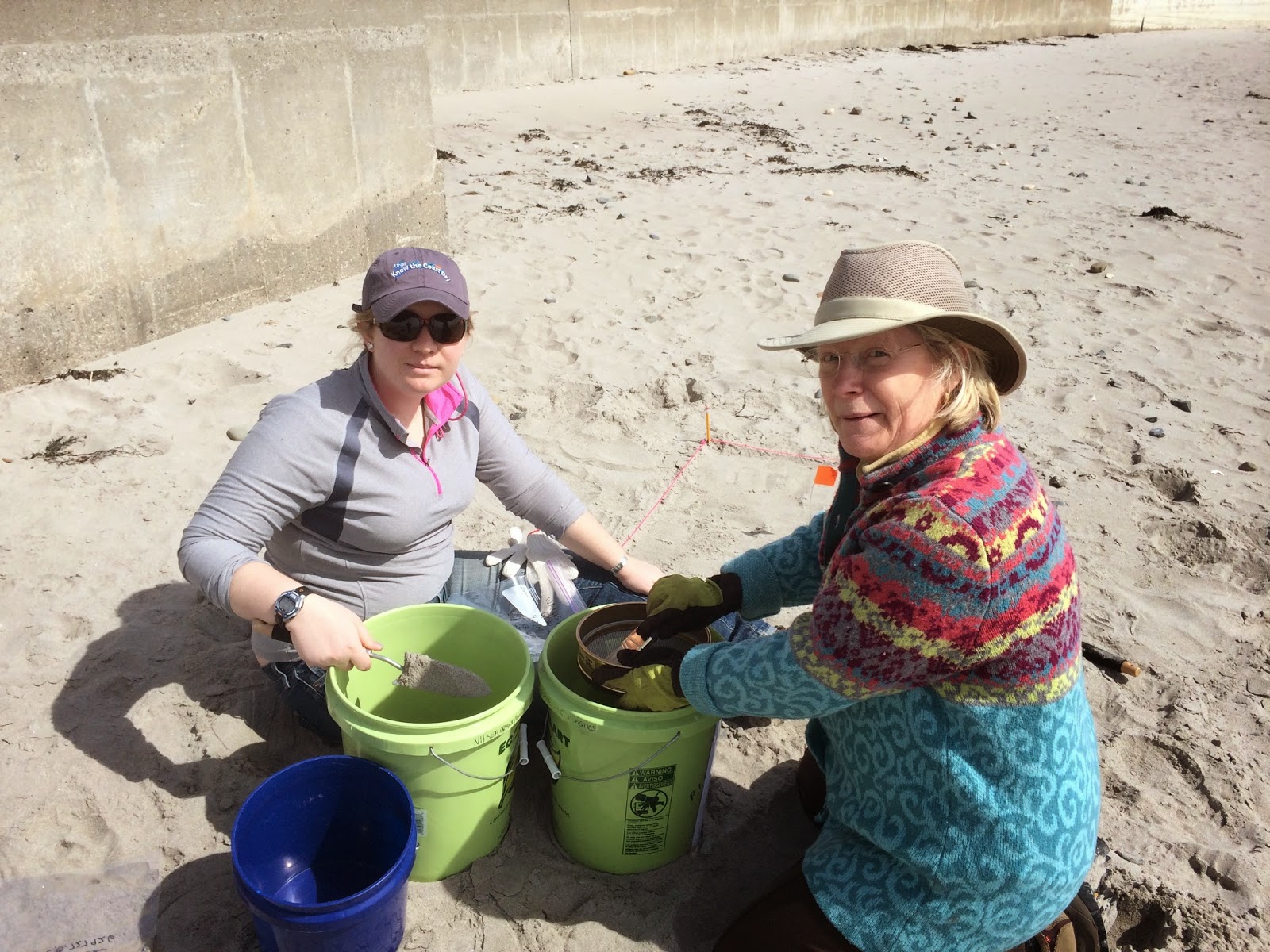
From April through October, we went to five NH beaches once per month to look for microplastics (plastics between 1-5mm in size). The beaches were several of our most popular local beaches: Wallis Sands, Jenness Beach, Hampton Beach, Hampton Harbor and Seabrook Beach. During the sampling process, we sifted the top layer of sand in a one meter squared plot. The samples were bagged, and now it's time for the fun part: sorting!
During the sorting process, we separate organic and inorganic material, then sort the inorganic material into several categories: foams (Styrofoam or insulation pieces), fragments (hard plastic pieces), films (e.g., straw wrappers), filaments (e.g., pieces of synthetic rope or fabric), plastic pellets ("nurdles"), and cigarette parts.
The process is a bit tedious, but yet oddly relaxing. If you'd like to help, we have several sorting dates coming up. Sorting will occur in Portsmouth, but space is limited so please RSVP and we can provide location and directions. All supplies are provided and we'll do a brief orientation onsite.
Sorting dates:
Wednesday, November 16, 2016: 3:30 PM – 6:00 PM
Monday, November 21, 2016: 10:00 AM
Monday, November 21, 2016: 4:00 PM – 7:00 PM
Wednesday, November 30, 2016: 5:00 PM – 7:30 PM
If you'd like to join us, e-mail Jen at jen@blueoceansociety.org or call 603-431-0260. Hope to see you there!
We estimate over 700,000 fibres could be released from an average 6 kg wash load of acrylic fabric.
- Napper, I.E. and R.C. Thompson (2016, In Press).
Helping the ocean starts with changing our clothes. The startling quote above was from a recent article in Marine Pollution Bulletin. It adds to the growing body of work showing that even the clothing we wear can impact the ocean.
For the past few years, we've been studying microplastics with New Hampshire Sea Grant. Microplastics are plastics less than 5 mm in size. They come from a variety of sources, including the breakdown of larger plastics. They can also come from our laundry. As we wash fabric, fibers flake off and get discharged in the machine's wastewater. It’s unclear what happens to the particles after that. Some get trapped during the wastewater treatment process, while others enter a local waterway during the discharge process.
While we don't fully understand this problem, recent studies show the impacts could be enormous. As mentioned above, washing acrylic fabric could produce up to 700,000 acrylic fibers during one load. Patagonia commissioned a study that found that washing synthetic jackets released on average 1.7 grams of microfibers per load. In Slovenia, scientists estimated that if each resident used a fleece blanket (washed 4 times per year) and a fleece jacket (washed 8 times a year), they’d result in the emission of 317 pounds of synthetic fibers into the environment each year. And these are tiny fibers that don't weigh much individually! In that study, scientists found that tumble-drying resulted in a release of fibers 3.5 times higher than washing. So, there's one more reason to feel good about hanging your wash on the line.
What’s the problem? Microplastics can be eaten by all members of the food chain, from tiny zooplankton to large whales. In enough concentrations, plastics can hinder the ability of marine animals to function through hindering their ability to eat, blocking digestion or leaching chemicals into tissues. We know crabs, mussels and fish eat microplastics. It doesn't take a huge leap to wonder about the effect of plastics on our own health if we eat these organisms.
Unfortunately, the impact doesn’t stop there. Microplastics can also host pathogenic bacteria and other pollutants that further contaminate waterways.
It’s an odd thing that we outdoorsy people, who can really benefit from synthetic fibers such as fleece and moisture-wicking garments, add to the litter problem every time we do a load of laundry.
As an organization, we’re trying to reduce our impact. This has included switching our Blue Ocean Society apparel to more eco-friendly organic cotton. We also distributed organic cotton t-shirts instead of synthetic fabric running shirts at our Run for the Ocean 5K in June. We’ve also been studying the prevalence of microplastics on the New Hampshire coastline.
Concerned about this problem? Here are some ways you can help:
Look at labels. Use clothing and bedding made of natural fibers such as cotton, wool, linen and hemp whenever possible.
Wash synthetic fabrics less frequently if possible, and air dry them.
Help us learn about microplastics on local beaches by volunteering to collect or sort sand samples.
More about our microplastics project, courtesy of NH Sea Grant:
References and Further Information:
Bråtea, I. L. N., Eidsvolla, D.P., Steindalb, C.C. and K.V. Thomas. 2016. Plastic ingestion by Atlantic cod (Gadus morhua) from the Norwegian coast. Marine Pollution Bulletin 112(1-2):105-110.
Bruce, N., Hartline, N., Karba, S., Ruff, B. and S. Sonar. Microfiber Pollution and the Apparel Industry. 2016. (Online). Patagonia/Bren School of Environmental Science and Management.
Mathalon, A. and P. Hill. 2014. Microplastic fibers in the intertidal ecosystem surrounding Halifax Harbor, Nova Scotia. Marine Pollution Bulletin 81(1):69-79.
Napper, I.E. and R. C. Thompson. 2016. Release of synthetic microplastic plastic fibres from domestic washing machines: Effects of fabric type and washing. Marine Pollution Bulletin 112(1-2):39-45.
We estimate over 700,000 fibres could be released from an average 6 kg wash load of acrylic fabric.
- Napper, I.E. and R.C. Thompson (2016, In Press).
Helping the ocean starts with changing our clothes. The startling quote above was from a recent article in Marine Pollution Bulletin. It adds to the growing body of work showing that even the clothing we wear can impact the ocean.
For the past few years, we've been studying microplastics with New Hampshire Sea Grant. Microplastics are plastics less than 5 mm in size. They come from a variety of sources, including the breakdown of larger plastics. They can also come from our laundry. As we wash fabric, fibers flake off and get discharged in the machine's wastewater. It’s unclear what happens to the particles after that. Some get trapped during the wastewater treatment process, while others enter a local waterway during the discharge process.
While we don't fully understand this problem, recent studies show the impacts could be enormous. As mentioned above, washing acrylic fabric could produce up to 700,000 acrylic fibers during one load. Patagonia commissioned a study that found that washing synthetic jackets released on average 1.7 grams of microfibers per load. In Slovenia, scientists estimated that if each resident used a fleece blanket (washed 4 times per year) and a fleece jacket (washed 8 times a year), they’d result in the emission of 317 pounds of synthetic fibers into the environment each year. And these are tiny fibers that don't weigh much individually! In that study, scientists found that tumble-drying resulted in a release of fibers 3.5 times higher than washing. So, there's one more reason to feel good about hanging your wash on the line.
What’s the problem? Microplastics can be eaten by all members of the food chain, from tiny zooplankton to large whales. In enough concentrations, plastics can hinder the ability of marine animals to function through hindering their ability to eat, blocking digestion or leaching chemicals into tissues. We know crabs, mussels and fish eat microplastics. It doesn't take a huge leap to wonder about the effect of plastics on our own health if we eat these organisms.
Unfortunately, the impact doesn’t stop there. Microplastics can also host pathogenic bacteria and other pollutants that further contaminate waterways.
It’s an odd thing that we outdoorsy people, who can really benefit from synthetic fibers such as fleece and moisture-wicking garments, add to the litter problem every time we do a load of laundry.
As an organization, we’re trying to reduce our impact. This has included switching our Blue Ocean Society apparel to more eco-friendly organic cotton. We also distributed organic cotton t-shirts instead of synthetic fabric running shirts at our Run for the Ocean 5K in June. We’ve also been studying the prevalence of microplastics on the New Hampshire coastline.
Concerned about this problem? Here are some ways you can help:
Look at labels. Use clothing and bedding made of natural fibers such as cotton, wool, linen and hemp whenever possible.
Wash synthetic fabrics less frequently if possible, and air dry them.
Help us learn about microplastics on local beaches by volunteering to collect or sort sand samples.
More about our microplastics project, courtesy of NH Sea Grant:
References and Further Information:
Bråtea, I. L. N., Eidsvolla, D.P., Steindalb, C.C. and K.V. Thomas. 2016. Plastic ingestion by Atlantic cod (Gadus morhua) from the Norwegian coast. Marine Pollution Bulletin 112(1-2):105-110.
Bruce, N., Hartline, N., Karba, S., Ruff, B. and S. Sonar. Microfiber Pollution and the Apparel Industry. 2016. (Online). Patagonia/Bren School of Environmental Science and Management.
Mathalon, A. and P. Hill. 2014. Microplastic fibers in the intertidal ecosystem surrounding Halifax Harbor, Nova Scotia. Marine Pollution Bulletin 81(1):69-79.
Napper, I.E. and R. C. Thompson. 2016. Release of synthetic microplastic plastic fibres from domestic washing machines: Effects of fabric type and washing. Marine Pollution Bulletin 112(1-2):39-45.
Microplastics sampling season is just around the corner but here is a quick recap of what we found out last year. The 2015 season was highly impacted by weather and a lot of recreational traffic on many of the beaches in the summer (not surprising, but frustrating!). We sampled five of NH's most loved beaches, Hampton Beach, Jenness Beach, Wallis Sands, North Hampton State Beach and Hampton Harbor beach from May until September.
During the 5 months of sampling we found the overall average concentration / beach was:
Beach
Overall AVG Microplastics
concentration pieces/m3
Jenness
3090
Wallis Sands
2890
Hampton Harbor
1762
Hampton Beach
1660
North Hampton
500
The seven main categories of microplastics found in samples were:
Pellets (pre- fabricated nurdles)
Fragments
Whole Pieces
Foams
Films
Filaments
Cigarette Parts
As with the previous year, the predominant types of microplastics found on these beaches were fragments and foams, although on Jenness Beach, prefabricated nurdles were the predominant type of microplastic found.
Along with collecting some interesting and sometimes unexpected data (such as the low concentrations of microplastics on Hampton Beach and the high concentration of nurdles on Jenness), in the years since we started sampling for microplastics we have also learned some valuable lessons which we hope will make sampling this year go more smoothly:
1) Do not try to sample all of NH 's beaches: NH Beaches are all very different with regard to topography, sand type, usage and most importantly, accessibility. We quickly realized that even though we originally set out to sample 12 beaches, that this would not be possible because some beaches were too rocky and others, because of the parking and residence restrictions, were nearly impossible to access. We have since narrowed our scope and try and sample 5-6 beaches once a month from April- October.
2) Keep it Simple: Since we depend on our volunteers, realizing that they are giving up their time to help out means that we needed to streamline our protocols and make this project as simple as possible.
3) Sampling doesn't always go as planned: The ideal sampling session is a beautiful day- 75 degrees, sunny, no wind and dry, dry, dry sand that can go through sieves easily, no parking issues and few people on the beach. These days happen, but when they don't it makes sampling frustrating and we need to adjust. If the sand is too wet, we either reschedule or we bag up the samples and dry them at UNH (or usually, my basement), if there are too many people, you have to reschedule (why summer sampling needs to happen in the early morning or the late afternoon) and if it is cold, overcast or windy, you just have to dress warmly and work quickly and efficiently. If the day is not ideal, plan to sample, but realize it could be rescheduled.
4) Many hands make easy work: This is where volunteers come in. Without our volunteers, this project, as fun, interesting and IMPORTANT, as it is, could not happen with the help of volunteers. The more we have, the better. On days when we have 6-8 volunteers, we can do a beach in 1.5 hours. When I sample alone, it can take closer to 2.5 hours. So please, sign up and volunteer and bring a friend!
This year, with the early onset of spring and the lack of snow on the beaches, we start sampling on April 11th! We have reduced the number of beaches from 12 to 6, and all beaches are readily accessible. Our protocols have been streamlined as best as possible and we hope to just do quick trainings on the days we sample. We plan on sampling every month beginning in April and ending in October. We also hope to have a few sorting sessions throughout so we can be all wrapped up by November.
Here is the schedule for April- again- we hope for perfect days, but we also realize that we may have to reschedule in case of weather.
Mon 4/11- 10 AM:Hampton Beach
Tues 4/12-10 AM: Wallis Sands State Beach
Thurs 4/14-1 PM- Jenness Beach
Fri 4/15-1 PM- North Hampton State Beach
Mon 4/18- 3:30 PM-Seabrook Beach
Tues 4/19-4 PM- Hampton Harbor
Please join us! We would love to have you! To join us, fill out a volunteer application and e-mail it to Jen Kennedy at jen (at) blueoceansociety.org!
See you on the beach!
Microplastics hashtags in the sand : #nhmarinedebris, #plasticisforever, #findthenurdle
Trash knows no season. On January 9, volunteers
at our monthly cleanup at Jenness Beach picked up 42 pounds of
litter. Their trash tallies included 149 pieces of plastic, 10 plastic bottles,
8 plastic bags, and even a condom.
Even during the winter, we find lots of litter. Some of it gets washed onto the beach by winter storms, and some is carelessly left behind by beachgoers or blows onto the beach from the street. All of it can be harmful to marine life if it
is left on the beach, which is why regular cleanups are so important.
Since 2001, we have cleaned Jenness Beach once a
month with the help of volunteers. The cleanups are open to the public –
individuals, families and groups are welcome.
In 2015, we removed 774 pounds of litter from Jenness Beach alone.
Our next cleanup is Saturday, February 13 at 10:30 AM. The cleanups are held rain, snow or shine. To sign up, call (603) 431-0260 or e-mail info@blueoceansociety.org.
Blue Ocean Society for Marine Conservation partners with GXT
Green for our monthly beach cleanups at Jenness Beach. GXT Green, based in Billerica, Mass., develops and markets
sustainable products and supporting services that cost-effectively solve the
everyday environmental concerns of corporations, communities and governments.
This includes solutions that reduce the environmental impact of plastic bags,
EPS foam packaging, and Greenhouse gas emissions.
Happy New Year! It's been awhile since we've posted... we're going to try to do better in 2016. Wanted to let you know about a couple upcoming events.
First is a screening of the movie bag it, followed by a discussion. The 45-minute film will be shown at Oyster River High School in Durham, NH. This event is hosted by Oyster River Sustainability Committee and we'll be leading the discussion! The free film starts at 6:30.
Also, our first cleanup of 2016 is this Saturday! Join us at Jenness Beach at 10:30 AM. All supplies are provided. Please RSVP to info@blueoceansociety.org.
The huge "haul" at Peirce Island, Earth Day 2006. Will we find as much this year?
Want to celebrate Earth Day and help marine life at the same time? Join us for an upcoming beach cleanup!
All supplies are provided, and the cleanups take 1-2 hours. You can even just drop by for 15 minutes, and that will make a difference to the health of a marine animal!
This green sea turtle in Belize was freed from a plastic tie. The turtle's body had grown around the tie. Green sea turtles are also found in the Gulf of Maine.John Chinuntdet, 2007/Marine Photobank
How Do Cleanups Help?
Marine debris can affect marine life in a multitude of ways. Animals can eat debris, which can then lodge in their digestive tract, blocking their ability to digest food. Or it can make them feel full so they don't each enough "real" food. If you want a really graphic example of the effects of marine debris, read this story to learn about a sei whale whose stomach was lacerated by a shard from a DVD case.
Items such as balloon strings and discarded fishing line can entangle marine life, with sometimes fatal results. If it washes out to the ocean, debris can also help transport invasive species and toxins.
Let's get it off the beach before it washes away!
Cleanup Schedule:
Saturday, April 18:
York, ME: Meet at 10:00 AM at Cape Neddick Beach. Hosted by Susan DeQuattro of Coldwell Banker Yorke Reality and Tina Bach.
Hampton Beach, NH: Meet at 10:30 AM at the Blue Ocean Discovery Center, 170 Ocean Blvd, Hampton Beach, NH
Portsmouth, NH: Meet at 11:00 AM on Peirce Island, on the small hill just past the city pool.
NH Sea Grant and Blue Ocean are gearing up to start microplastics sampling again for 2015. Because the winter has been so drawn out, we have not been able to get out and get onto the beaches to see what kind of micro-debris winter has deposited on our coastline. Based on our year-long pilot study, we have been able to determine which beaches are the most impacted by microplastic debris and will become the focus of this year's sampling efforts. We will also continue to sample the other beaches but not as intensively. The 5 main beaches that we are looking for consistent volunteer help include: Hampton Beach, Hampton Harbor, Jenness Beach, Jenness Beach at Cable Rd and North Hampton Beach. The other beaches, Wallis Sands, North Beach and New Castle Beach will be sampled less frequently along with Seabrook Beach. We are in the process of setting the sampling schedule and as soon as that is finalized we will be conducting some trainings and recruiting volunteers. For more information please contact Gabby Bradt at NH Sea Grant, 603-862-2033 or gabriela.bradt@unh.edu.
The Stewardship Network recently wrote an article about our efforts, click on the picture and have look!
Microplastics, bottle caps and straws by the hundreds... this is what we encountered when we arrived at Race Point Beach in Provincetown, MA for our annual cleanup during the annual New England Whale Watch Naturalist Workshop. The workshop, hosted by Dolphin Fleet of Provincetown, Center for Coastal Studies and Whale and Dolphin Conservation, is an opportunity for whale watch naturalists from around New England to get together to share ideas and learn the latest updates in whale research and conservation. And sometimes, we're lucky enough to even be able to see whales from the beach! But this day it was a bit too foggy.
Cleanup volunteers on a foggy beach
For the last several years, we've worked with the Jesse Mechling, Marine Education Director at the Center for Coastal Studies, to organize a beach cleanup at one of Provincetown's long, beautiful, but sadly trash-ridden beaches. Not only is the cleanup a great team-building and networking opportunity, but it allows us all to make a real difference in the health of local marine life populations by removing marine debris before it washes into the ocean, where it can impact whales and other marine animals through entanglement or ingestion. We also collect data on our findings, and can compare them from year to year.
Sand-covered parking lot at Race Point Beach in Provincetown, MA
This year, first of all, we arrived to find that half the Race Point Beach parking lot was covered with sand due to winter storms. That gave us a good idea of what to expect on the beach, as we headed down to the shore and found lots of storm-tossed debris, especially in the wrack line (the line of seaweed and debris left behind as the tide recedes).
We found a lot more small plastics than we expected. And as an unfortunate example of the persistence of litter, we found 10 biofilm chips from the spill that occurred from the Hooksett, NH wastewater treatment plant on March 6, 2011 (read more about that here).
Bottle cap on the beach
Thanks to the 19 volunteers that helped with this cleanup and removed 40 lbs of debris from the beach in less than an hour! Here are the totals for what we picked up:
Additional items included: Cigarette packaging, zip ties, an oil drum lid, glow sticks, sunglasses, a spoon, 2 cups, 2 (unmatched) boots, a shotgun shell, a razor and a toothbrush.
Us "whaleheads" are always happy when we can be outside
Thanks to everyone who helped!
Want to participate in a cleanup? Learn about Blue Ocean Society's upcoming cleanups here.
For the last several years, we have gone out to the Isles of Shoals and conducted coastal cleanups of the islands. Often, we came back with many unfishable lobster traps that had gotten lost and then washed up on shore. We have also conducted a few side-scan sonar expeditions in Gosport Harbor on Rozalia Project's sailboat, American Promise. We have seen the bottom of the Gosport Harbor littered with lost traps and other debris and always hoped (and even applied for funding) that one day we would be able to not only detect the gear, but also RETRIEVE the gear. Well, we got our wish!
Jen Kennedy and Capt. Lee Schatvet
Last week, in collaboration with World Animal Protection (WAP), NH Fish and Game and lobsterman Lee Schatvet (F/V Yesterday's Storm), we (BOS and NH Sea Grant/Cooperative Extension) were finally able to go out and detect and mark lost/inactive lobster traps with Humminbird side-scan sonars that were loaned by Virginia Institute of Marine Science. Then, we were able to go back and retrieve some of the gear that we found. This was a two-day project made possible by funding support from WAP and our partnerships with NH Fish and Game and Capt. Schatvet.
Our first day , Wednesday, August 27th, Jen Kennedy (BOS), Elizabeth Hogan(WAP), Kara Wooten (WAP) and myself (NHSG) boarded the Yesterday's Storm and headed out towards the Isles of Shoals with our eyes glued to the screen of the Humminbird, which Lee had mounted on the side of his boat.
Elizabeth Hogan (left) and Kara Wooten from World Animal Protection (WAP)
Now, the Humminbird is a great piece of equipment and relatively easy to use, however, the big challenge was being able to see the screen in bright sunlight as well as figuring out if what you were seeing on the screen was really a lobster trap or just rocks. Additionally, once we were sure that what we were looking at was, in fact, a trap, was determining whether it was, in fact, a lost/inactive trap! This required confirmation of the presence or absence of a lobster buoy before we were able to mark the spot as a potential waypoint for the next day. The Hummingbird worked very well in shallower water, but the deeper we scanned, the smaller the traps appeared and sometimes we couldn't detect anything at all.
The Humminbird 1197c side-scan sonar
We spent most of Wednesday doing transects, looking for traps both in Gosport Harbor and later at the mouth of the Piscataqua River. In all, we were able to mark 34 potential lost traps for us to go back and try and retrieve the next day.
The next day, Thursday, August 28th we met at Rye Harbor at 7 AM and NH Fish and Game Conservation Officer, Dale Gargac was waiting for us. In order to be able to do this kind of project in NH waters we need to have a CO present to ensure that what we are hauling up is not an active lobster trap and that the traps we do haul up that are inactive need to be examined and deemed fishable or unfishable. Touching a lobster trap without the expressed permission of the owner OR without a CO present is illegal under NH law, so it CO Gargac's participation and presence was important and required.
We arrived at one of marked waypoints around 8:30 AM and we quickly got to work. Capt. Lee had soldered together a heavy duty grapple which is what we needed to lower and drag in order to hook lost gear.
Gabby Bradt hoisting the custom grapple
While Lee lowered the grapple, the rest of us got ready with data sheets and kept an eye on the sonar. However, even though we may have marked locations of potential traps, getting back to that exact spot proved difficult because of the tide and wind. On the third grapple drag, we hooked something in the general proximity of several marked traps and we all cheered and hoped that we had hooked a "ghost" trap. Well, we hooked a ghost trap for sure, along with 7 others- in fact we had hooked onto a lost 8-trap trawl. This was amazing but we were not expecting to deal with so many traps all at once. Lee used his winch to haul up trap after trap and we had to jump into action, collecting data, photographing the traps and seeing and counting what animals were inside and outside of the traps. We had to move quickly in order to return the animals back to the water before they expired. It was exciting and at times chaotic! We also had to process the traps and move them out of the way to make room for others.
Capt. Lee Schatvet lowering the grapple
A beautiful sight- hauling up a lost trap- the first of many that day!
A lost lobster trap covered in kelp, sponges and tunicates
While we processed those first 8 traps, Lee kept on grappling in the same area and suddenly, we were hooked on something else. Yep, he started hauling up a 10 trap trawl, also lost. More data collection, more pictures, lots of "look at all these amazing critters we never get to see" exclamations and lots and lots of Jonah and rock crabs, brittle stars, blood stars, lobsters, fish, worms and spider crabs that used seaweed as camouflage.
All told, we found 24 lost, inactive traps, most of which were still in really great condition and could be used again and over 400 pounds of inactive rope and line. We were able to release about 127 animals (lobsters, crabs and fish), 51 of them were lobsters, some with eggs, back to the ocean. While at sea, CO Gargac called the owner of the traps and we were able to return 19 traps to him when we returned to Rye Harbor. The rest of the traps were deemed unfishable and we disposed of them in a dumpster at Rye Harbor along with the 400 pounds of rope and line. The traps and ropes were then taken to a waste to energy facility where it would be turned into electricity.
Elizabeth Hogan (WAP) and Jen Kennedy (BOS) processing a ghost trap
Elizabeth Hogan (WAP) returning a beautiful Sea Robin back to the water
Lost trap "Mountain"
Captain Lee Schatvet using a lift to bring the traps onto the dock
Our goal for this expedition was to find and retrieve lost gear in NH waters to prevent 'ghost fishing' and to make the ocean a bit safer for marine life and for other ocean users. In NH, approximately 10% of a lobsterman's traps are lost every year as a result of weather or other boaters cutting the lines accidentally. These traps are expensive and the economic impacts are significant in loss of gear and loss of potential catch. The traps continue to work, they continue to fish even if they are not being actively hauled by their owners. Additionally, lost gear can accumulate into larger, entangled 'balls' and become safety hazards for both commercial and recreational boaters. Being able to successfully remove lost gear, return animals to a cleaner habitat, remove potential hazards and return useable equipment to its owner was incredibly rewarding. Working collaboratively with WAP, NH Sea Grant, NH Fish And Game and Capt. Lee was a clear example of the amazing things we can accomplish together and properly and within the confines of the law. All of the logistical pieces worked as they were intended and we were able to do some good in many aspects of this complicated issue.
Mission accomplished. For now.
The team. From left to right: Capt. Lee Schatvet, CO Dale Gargac, Elzabeth Hogan (WAP), Gabby Bradt (NH Sea Grant), Jen Kennedy (BOS) and Kara Wooten (WAP).
Today, we set off from Rye Harbor at 7 AM intending to go out to White Island, one of the Isles of Shoals. We know that White and its adjoining island Seavey have some old lobster traps and other debris that needs to be removed. Working under a grant from the Fishing for Energy Partnership, we had already secured a dumpster from Northeast Recycling and permission from NH Fish and Game to remove the (unfishable) traps.
White Island, with skiff approaching
As we've found out time and time again when doing these island cleanups, not everything happens as expected. We knew the swells out at the islands might be tough. The island is only accessible by small boat (i.e., a skiff or inflatable), since there isn't a dock on the island. But, we had a very tight weather and biological window in which to do the cleanup. It was a bright, relatively calm and sunny day, and it was one of the last days we could go out to Seavey Island to retrieve marine debris before we would bother nesting terns.
As we got to the island and launched the skiff from the fishing vessel Yesterday's Storm, it soon became clear that it would not only be difficult simply to land on the island - it would be nearly impossible to load derelict lobster traps and other debris onto the skiff, so we could transport them onto the fishing vessel and bring them to the dumpster in Rye Harbor. OK... on to Plan B.
Amy Warren and the iconic Haley House on Smuttynose Island
Not wanting to waste vessel time or that of our staff and volunteers (who, after all, had gotten up super early to pick up debris with us!) we decided to switch gears and see if we could do a cleanup on nearby Smuttynose Island. We did a cleanup on Smuttynose last year and found a lot of debris, and it is accessible from the relatively sheltered Gosport Harbor. That cleanup seemed like a piece of cake in comparison - we quickly found an available mooring, drove over to the island by skiff, and spent the next 3.5 hours combing the island for marine debris.
There aren't any terns to worry about here - but there are great black-backed gulls, and they weren't always too excited to see us (even though we kept telling them that we were ridding their habitat of harmful marine debris). We can't say we weren't warned...
This is a sampling of what we found:
66 Lobster Trap Pieces
37 Pieces of rope (including two pieces that were about 240 and 100' long!)
3 Beverage Cans
8 Balloons
4 Plastic Bags
49 Plastic Bottles (it always astounds me how many plastic bottles we find on these islands... and none even have messages in them...)
37 Pieces of plastic
64 Pieces of foam
118 Pieces of glass
Some of the more unusual things were: a wooden chair seat, 2 combs, a flip flop, 2 big foam chunks, an orange fender and a large plastic sugar container.
Gabby Bradt from NH Sea Grant, with our haul from the day
In all, we picked up 228 pounds of marine debris from the island - litter that could have threatened the seabirds living on the island, or washed out to sea where it could harm other marine life, such as seals, whales, sea turtles, seabirds and smaller marine animals that make their home in the Gulf of Maine.
We have had a great season of Shoals cleanups so far - before today, we had already removed about 700 pounds of marine debris from Star Island and Appledore Island. We are still hoping to get out to White Island to get that debris before the end of June... stay tuned...
Our new recruits! 2 beaches down, several more to go!
Finally!! After a very long winter and some panic that the weather would not improve in time for microplastics sampling season, here we are, in full sampling mode! We have had several successful training sessions at the Blue Ocean Discovery Center in Hampton and I am so pleased with our new recruits! Their patience and eagerness to help out with this "kinks-still-being-ironed-out" project has been refreshing and really enjoyable. The microplastics study is really exciting and interesting but it is also a work in progress as we try and figure out the best way to sample our beaches given the weather, topography, the number of volunteers and the time that it requires. With all this in mind, the fact that we have such enthusiastic volunteers is wonderful and I thank you!
Wallis Sands State Park-sampled April 7, 2014
For the entire month of April, we will be sampling 12-15 NH beaches and I am pleased to say that we have completed two beaches already, Hampton Beach State Park and Wallis Sands State Park. Both of these sampling outings took place on gorgeous days, which made the time pass by! These two beaches are part of 5 beaches where we have added two more sites with the hope of capturing more of a "microplastics signal". By adding more samples, we hypothesize that we will be able to collect more microplastics and get a better idea of how and where microplastics are accumulating. Thus far, we have observed that microplastic accumulations appear to be very patchy. Hopefully, this subset of beaches with the extra samples will help elucidate some patterns so that we can modify our protocols if need be.
Microplastics on our beaches-this is what we are looking for!
In addition to some new Blue Ocean volunteers, we have a star team from the Coastal Research Volunteers (CRV) from UNH. This group of 5 are returning to sample more beaches and they have experience with the protocols and the technology and have been eager to get going. They will be sampling 4-5 beaches that have one designated sampling site.
We hope to finish our sampling by April 30th and we have some dates reserved for the next phase of the data collection- SORTING! Sorting the samples will occur in May which will then give us time to enter the data and do some preliminary analyses before we have our final sampling blitz in August.
We are always looking for extra hands so if you are interested in volunteering, please get in touch with Gabby Bradt or Jen Kennedy for more information.


.JPG)